4th Grade and the Akeda

Good afternoon 4th Grade families,

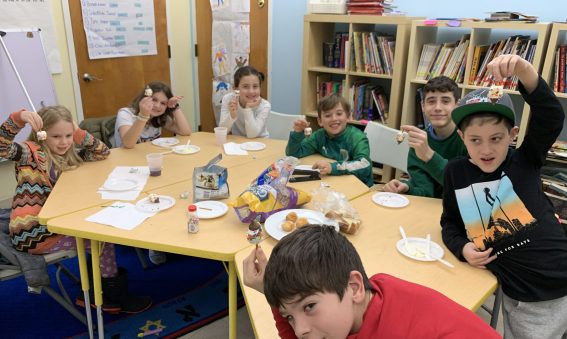
This week we learned the Akeda / the Binding of Isaac, in which Abraham nearly sacrifices his son!! The students loved the intensity and suspence of this dramatic story (though they generally felt sorry for the ram who got sacrificed instead).

Questions abound in this mysterious text. How did Isaac feel about his dad Abraham nearly sacrificing him — that’s not what dads are supposed to do! How about Sarah, did she know this was going on, what did she think/do about it? Why didn’t Abraham argue with God (in a previous story, Abraham argued with God to save his nephew, but he didn’t even argue about his beloved son)!  Did Abraham or Isaac suspect that an angel was coming to save the day, or was it a total surprise to both of them?

More questions for families: What would your child do if they had to sacrifice something they loved — would they do it, would they refuse, would they argue, or try to find another way?

What tests do we face — not as in the Pacer or other standardized tests, but as in, when is somebody trying to see how we behave?

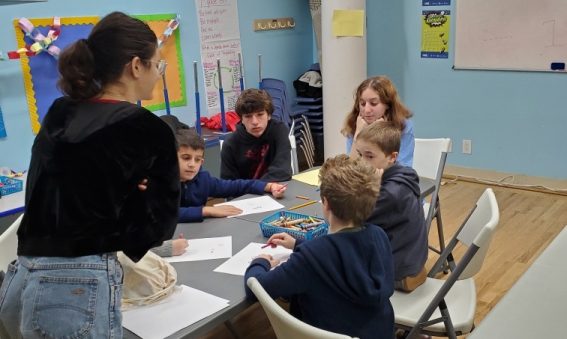
For an artistic child (since I’d made original illustrations for our telling): what choices do they make when they’re illustrating? How would they like our Torah heroes to look? They could look like anyone, after all.

For an Israel-loving child, you can still visit the mountain in the land of Moriah where this Torah story takes place. What do you think it looks like there?  Can you find pictures together?

Anyway, it’s a very toothy story, and we had great fun exploring some of the moral dilemmas it presented.  Enjoy!
4th Graders are heroes, too!

Announcements:

Kabalat Shabbat B’Yachad (KSBY) 4th Grade will be Jan 24, 2020.  5:30-7pm.  Sign up here:  https://cbebk.shulcloud.com/yachad/ksby-4th-grade-2020

(When you RSVP, that makes us able to have enough staff and enough food for everyone, so don’t forget.)  It’ll be lovely, with songs, food, fun activities, and each other.

Upcoming Closures: No Yachad on MLK Jr Day, Monday 1/20. But we have a special MLK family event in the rotunda (see below)! Yachad classes ARE happening on Saturday 1/18.

MLK Repair The World Day of Service @ CBE CBE is hosting Repair The World’s family MLK activities in our rotunda: There will be three service projects conducted simultaneously: mural painting (children with adults welcome), poetry writing (adults welcome), and packaging hygiene products for St. John’s Bread & Life (all ages welcome). Because each project involves a lot of work, they will be completed over the course of two shifts (9:30-11:00, 11:00-12:00), which people can register for via the Repair the World brand new MLK website (please search for this event on 1/20- there is no direct link). 

Creative Arts Academy camp information session @ CBE,12:30 – 2pm, RSVP to Hbreskin@cbebk.org. 1/18, 3rd – 11th Grade families


This week, our 4th Graders learned the story of Abraham and Sarah, who laughed when they learned they’d finally have a child with each other, whom they’ll name Isaac.

We talked about welcoming people in, like our Torah heroes Abraham and Sarah. We talked about laughter, and breifly about tact (since God lies to Abraham about why Sarah is laughing).

We don’t live in an open tent in the desert, where we can look out for travelers to welcome in — how do we welcome people into *our* communities — our homes, our friend-groups, maybe even our country?

How do we decide when to use kind tactful words (so as not to hurt people’s feelings or make them fight) vs. when to use really tough words (such as when we need to stand up to a bully or oppressor)?

Read More

4th Grade: Dreidl pics, and Chanukah discussion topics

Hi 4th Grade families, I just came across these eight little Chanukah write-ups, and I thought they could be nice jumping-off points for any families who love having discussions together around their menorahs.  Feel free to use any at home that are your style.

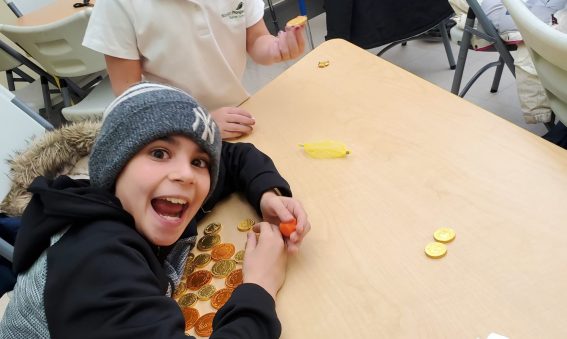
Also, here are a few of the Tuesday kids playing dreidl together at the very end of the day.  One player has only one piece of gelt left, while the other just won a zillion; they wanted to pose at the height of drama.  (We were relieved that we’d decided beforehand that we’d split all our gelt evenly at the end. Indeed, these two good-natured students also enjoyed a house rule that, when they rolled a Nun, the luckiest dreidl-player could pay “taxes” to help out his less-lucky playmates.  We all liked that we had everyone taking care of each other. Chocolate healthcare for all??)

Happy Chanukah,

– Morah Leora

The Pardes Hanukah Companion

Happy Chanukah, 4th Grade!

Reminder that you’re invited to our Chanukah party, just a few days away, on Dec 20 — just sign up here:  https://cbebk.shulcloud.com/holidays/hanukkah-youth-family-celebration-2019

Our 4th Grade scholars are taking a historical tack on Chanukah this year. Through games, discussions, and illustrating a book together, we learned about the military history of this holiday: what’s supported by historical research (the Jewish uprising against the Syrian-Greeks! Rededicating the Temple! Guerrilla warfare!), and what legends were probably added in afterwards (the miracle with the oil! dreidls!). We talked about why we teach these cool legends, even the parts that probably didn’t happen that way historically.  According to one 4th Grade scholar — and I agree — “We can learn true things, even from stories that aren’t true.”  In this case, we’re learning about standing up for what is right.  We’re learning that great stories can inspire our people towards peace, and towards uprisings, too.

We focused on who was an upstander in the Chanukah legends.  We’re ready to stand up for what’s right even today – whether that’s protesting, talking to people in charge, emotionally supporting somebody who needs help, or other ways to help create change when change is most needed.

We also enjoyed knowing that we can love our non-Jewish friends, while also being proud of who we are; our uniqueness and our diversity.  (In my humble opinion, that’s the True Meaning Of Chanukah – though I’m sure the kids consider snacks and modern presents to be much more significant factors, hah!)

Read More

A Military Chanukah for 4th Grade

Happy almost-Chanukah, 4th Grade families!

Our 4th Grade scholars enjoyed learning the story that they thought they knew, but *didn’t* know: the historical basis of Chanukah.  It’s not just the friendly story with the oil, it’s got exciting military stuff in it, too!

If your kid was among those fascinated by learning a complex military history, and you want to be even further up on the history than they are, with some Game-Of-Thrones-level political intrigue, here’s a 6min read on it: https://www.haaretz.com/israel-news/the-revolt-of-the-maccabees-the-true-story-behind-hanukkah-1.5343197  (Hellenizing means to become like Greeks.)

Here’s the text of the story that I wrote for 4th Grade.  The students chose a page to illustrate with their friends, either to take home, or to create our own Chanukah scroll to display in the classroom.  https://docs.google.com/presentation/d/1Pbk-_n6ktdCjuw2r2su-O5wOGi6tsj2s8Ky7Idttbio/edit?usp=sharing

For a historically-minded child: Enjoy going into the historicity of this holiday story. Which parts do you think really happened, and which are probably legendary? Why do we tell marvelous legends even if they probably didn’t technically happen just how they’re told — what truth can we learn, even from the bits that were probably added after the fact?

(For example: the story about the oil was probably added because the Talmudic rabbis were living under oppressive Roman rule, and the teenagers in the community wanted to fight back against the Romans. The Roman army was a LOT bigger than the Syrian-Greek army, and the wise Talmudic rabbis were afraid that, if they told these youngsters a story in which we totally won against a big oppressive army, their teenagers would be inspired to fight the Romans… and the Romans would wipe the floor with them. So, the Talmudic scholars tried to protect the teenagers, by emphasizing a story about oil lamps, instead of emphasizing the one featuring a military victory against a larger oppressor.  So – we can learn that it’s really important to protect people in our communities. We learn the power of stories, whether for war or for peace!  What would your child have done, would they have emphasized the truth, or would they have emphasized a safer story, instead? Why?)

For a creative child: Whenever we make art based on Judaism, we emphasize that Judaism belongs to the students, and that they get to make art, music, math, whatever they like out of it. What is their favorite medium in which to create? How might they use their Judaism as the raw material for a song, a math problem, a dance, a work of art, a scientific inquiry?

For a child who loves to change the world: Next class, we’ll take the Maccabees into the modern era, and talk about others who stand up against oppression for what is right.  What problems do they see in the world, who is helping to fix those problems? How might they bravely help, now or in the future?


4th Grade scholars just keep learning

Hello 4th Grade families,
Since last we checked in here, our 4th Grade Scholars have been covering the stories of Sarah & Abraham’s call to adventure, Sodom & Gomorrah, and the complex family dynamics of Sarah, Abraham, and Hagar.

For Sodom & Gomorrah, we made a cool 3D project of those very wicked cities. We had deep class discussions about it while building. For example, was destroying the cities really the only option? Can people really be wicked on the inside, or do they just make bad choices? The students then thought about what kind of person they each want to be, and what kinds of friends they want to make, to help them get there. At the end of Sodom & Gomorrah: in accordance with positive Torah commandments, the kids got to be the fireballs, and smash the wicked cities that they’d built — it was a super fun way to see how the ethical Torah shows us both what we shouldn’t do, and what we should do, instead.

Next, we covered the relationship between Sarah, Abraham, Hagar, and Ishmael. It’s a very complex story with a lot of family relationships in it, which fascinated our highly social scholars. We wrote scripts exploring the moment that Sarah set up Abraham and Hagar together and enjoyed our diverse interpretations of the characters’ reactions.  Inspired by the diversity of interpretations, we found a key to why Sarah/Hagar/Abraham all got super upset at each other: if you read the text very closely, Abraham tells Hagar she’ll be his wife, but Abraham tells Sarah that Hagar will still be Sarah’s slave. Whoops.

For Hagar, we tried to understand how she felt, and why she ran away. (Have you ever had too many different expectations on you, all at the same time?)

For Sarah, we had the Sarah cutout listen as we played some Mister Rogers (“what do you do with the mad that you feel”), so Sarah could find some better ways to deal with being angry, instead of taking it out on Hagar.

For Abraham, who didn’t intervene when Sarah mistreated Hagar, we did an activity about how to be an upstander, like if you see people bullying or discriminating against somebody.  We made pocket guides for intervening with bias – if only Abraham’d had a pocket guide like this, maybe he could’ve stopped Sarah from mistreating Hagar in the first place!

Some of the classes had time to really get into anti-bias.  They were particularly fearsome in defending against hypothetical antisemitism, so we used that energy for other discriminations, too. Go, upstanding students!  In all classes, we talked briefly about slavery and anti-bullying, in the context of the story and our lives.  Those who want to continue this discussion at home, there’s a whole lot of meat there!

4th Grade: Cain and Abel

This week, 4th Graders have waved goodbye to the Garden of Eden, and learned the dramatic story of Cain and Abel, through carefully crafted pictures on the rug, and a scholarly discussion together.

  • Interestingly, every single class had at least one student who noticed some discrepancies in the Torah, and wondered whether Adam and Eve were really the only people around during this time (because, if they were the only people, whom did their son Seth go and marry? and what people were even looking at Cain’s mark? etc.) We love asking big scholarly questions like that, and came up with very cool interpretations together.

On Saturdays, 4th grade has additionally been learning more about Shabbat. Students learned the blessing for lighting the candles, wine, and challah. They took turns reciting the blessing over the candles and practicing the movements that go along. They put all the blessings and rituals into sequence, and played a memory game to show off everything they’d experienced during the class.


Discussion Questions for Families: The Cain & Abel Torah story is juicy.  You can basically pick any detail in the story and ask why.

  • God told Adam and Eve to be responsible for the world. Some people think that this means that we should be in charge of the planet, and some people think it means we should nurture the planet. Which do you think?  How do you think that Cain (the tough shepherd) and Abel (the gentle farmer) might’ve interpreted what it means to be responsible?
  • When Cain got jealous of his brother Abel, he killed Abel! This was very clearly the wrong choice, and Cain gets punished big-time in the story.  What could Cain have done instead, to deal with his anger/jealousy more productively? (Like, if we were there, with all our good skills of how to deal with our feelings, what might we have advised Cain to do?)
  • In the story, Cain was the first person on earth who’d ever hurt somebody else. Therefore, could he really have understood what would happen?  Does it change the story, if Cain realized what he was doing, vs. if he didn’t?
  • Was a permanent mark the best justice for Cain’s terrible crime of murdering his brother?  What are some other ways that we could handle it when somebody commits a huge crime in our community?  Should there be a way for a murderer to eventually earn forgiveness, or not?
  • The text says that, after Abel was dead and Cain was sent away, Adam and Eve (their parents) comforted each other, and had a new baby, whom they named Seth. When something goes very wrong in our community, and it isn’t our fault, how can we comfort each other, how can we try to rebuild?

If all that is a bit too gritty for you and your child, maybe talk about Shabbat, instead. 🙂

  • Every family relaxes and refreshes differently. What does our family do to relax and refresh ourselves together?
  • What are our ritual objects, and where do they come from?
  • When you grow up, you’ll be in charge of creating your very own Shabbat, too. What will your Shabbat be like? What will it include?


4th Grade: Creation Play

Announcements


  1. Closures: There are no Yachad classes on Tuesday Nov 5 for Election Day or on Monday Nov 11 for Veterans Day. 
  2. Camp Style Havdalah Pool Party, Saturday, Nov 16, 3-5pm. 

Families that are already connected to URJ Camps will join with prospective campers and their families for a fun night with havdalah, swimming and camp-style games.  We look forward to seeing you there! Register here by Nov. 8th. All welcome; 2nd – 6th grade focused.

Read More

4th Grade and the Timeline of Judaism: You Are Here

Many students wanted to know more about what order all these exciting Jewish holidays and history take place, and how they fit into other important events in the histories that they know from home and school.  For example, in the Torah, when was Noah’s Ark, when was Moses? How does the Chanukah story fit in, that’s a great Jewish story but it’s not even in the Torah at all! What kind of technology was invented yet for different holidays; did the Maccabees have guns?  How does the Purim holiday story even fit in — it has its own book and takes place in ancient Persia??  And how does any of this fit into American history? When did my particular family arrive in this country?

So, we checked out a very long timeline of important Jewish events — from the legendary times of the Creation story, through archaeological times of many Torah stories and ancient Israel, all the way through modern history, to today (2019: You Are Here).  Students got to see just how long our shared timeline is, drew illustrations of their favorite events, and played many fun games with it.

Read More

4th Grade: Simchat Torah and V’Zot HaBrachah

Have you ever had a book that you loved so much that, as soon as it was over, you could hardly wait to read it AGAIN?  For Simchat Torah, that’s exactly what the Jewish People do with our favorite book, the Torah — when we get all the way to the end of the Torah, we throw it a huge dance party, and we start reading all over again!

Thank you to everyone who was able to come to the Simchat Torah celebration at CBE. There was crazy unexpected record turn-out, and it was so fun to dance with everyone!  Don’t worry if you missed it, though – it’ll come back around for you next year, too.


Yael and Edan write:
In Hebrew Through Movement, 4th grade worked on these verbs  – to touch, to draw. Nouns: apple, candle/s, honey. They were also introduced and continued working on different body parts – head, eyes, mouth, nose, ears, hands, belly and legs. They are currently working on the different colors.
—————-
Lauren Hart writes:
Hi Parents! This week we played a super fun and interactive game where we dealt with problems for Moses and the Israelites from the last portions of the Torah. We split into two teams and both were given time to figure out answers that were mostly acted out! They love to get up on their feet and act so I’m looking forward to more of that in the coming weeks. On Tuesday we celebrated Simchat Torah by making tiny Torahs that are inscribed with a blessing, or with something special and/or secret to each child. We also illustrated the very last and very first verses of the Torah. It was lots of fun!
——————
and from me, Morah Leora:
Our 4th Graders understand that scholars love finding problems in Torah text! With our Bucket O’ Problems game, students considered and tried to solve issues from the last portions of the Torah.  (Lauren Hart played this game too! To expand, here’s an example of the problems the students faced: Imagine you’re Moses, and you don’t get to enter the Promised Land, even though you worked super hard and were a great leader. Moses accepted his fate, but, do you think this is a problem? What would you do? — Bonus, would your answer change if you were 120 years old?) (Another example: What if we get to the Promised Land, but there are already people living there, who won’t let us in?) (Or, what if we’re living happily in the Promised Land, and several years later, new people want to move in, too? Should they get to live in the Promised Land with us, even though they didn’t fight for it?)  We had fascinating discussions, which ranged from explorations of midrashim, to peaceful and not-so-peaceful solutions to impending biblical war, to immigration issues that subtly reflected what they know of modern America.  Our empathetic scholars really know how to dig in and make connections and solutions.