


Worries, Jealousies & Courage to Lead
Jewish Studies
Andrew’s Monday/Wednesday Class
In the spirit of Passover, we are continuing the story of the Jewish exodus out of Egypt. The week was started challenging the students to think why was it important for the Israelites to roam for 40 years and what this period of time may have looked like? The students read the story of the spies entering the land of Israel to see if it was a safe place to live and what were the results of their actions. They role-played in interview skit form the scenes and brought them to life. We continued this on Wednesday to debate what they would have done if they were the spies and held a conversation around what it means to be a hero. Next week we will be officially deep-diving into Passover!
Lee’s Monday/Wednesday Class
We started by discussing fun April Fool’s Day jokes we had heard, and entered into the theme of our lesson by students giving examples of a time when they might have done something they thought they should even if it was scary or hard. We then got a little preview of what’s coming up next in our story, as part of our Passover preparation, by looking at The Ten Plagues (April Fool’s style), with a couple of the plagues replaced with silly alternatives and the students being tasked with trying to guess which real plagues had been replaced. We continued in reading our Moses story, with students taking on various roles. After learning about Moses and the Burning Bush, where he says that he is ‘slow of speech’, we turned our attention to a Midrash (commentary) which explains Moses’ difficulty speaking. Following a discussion of that Midrash, each student spent some time writing a few reasons for why Moses should feel less afraid and why he might be the right person for the job despite his reservations. Students shared some of their thoughtful ideas and suggestions for Moses, drawing from details from the stories we’ve already learned about him, and their own creative ideas about how to muster courage. We then looked at other examples of students who might be hesitant to take on a challenge, and students created and shared ways to get past the excuses and do what needs to be done.
David’s Tuesday/Saturday Class
This week we learned about the Ten Commandments and the sin of the golden calf through movie scenes, stories and games. We talked about the crisis after the spiritual climax, about the desire for a god with a body and realism. We also dealt with Korach’s rebellion against Moses and the continuing doubts and challenges of the Israelites during their desert wanderings. As part of the rebellion, Korach and his followers claimed that they were all equal and questioned why God is not revealed to everyone equally. To explore this theme and related questions we played a game of marbles and reflected on how equality and fairness are not always the way of the world and sometimes there is a reason, and other times not. The people’s worry of God and Moses’ absence at Mt Sinai, which led to the creation of the golden calf and this rebellion addressing the lack of equality in God’s relationships with all the people raised interesting conversation among the students, which we look forward to continuing next class.
Lee & Marna’s Tuesday/Saturday Class
On Saturday we reviewed the Exodus story, starting with the 10 plagues and moving into Moses guiding the Israelites across the Red Sea. We discussed transitions and the challenges and freedoms they offer. The kids reflected on transitions in their lives. One student mentioned her brother turning 19 and we reflected on the ways transitions for other people often affects us as well. Another student spoke about transitions in government and the ways this impacts us on a national scale. We mentioned the transition into spring as well!
We then spent time focusing on Moses’ leadership and in general how leadership can sometimes paralyze people and cause them to pause and not take action, and the ways that taking deliberate action may be required to be a good leader. We watched the bimbam video about Nachshon’s leadership and how his faith in God enabled him the trust as he began walking into the sea. The midrash (commentary) mentions how all the people followed Nachshon and only then did God part the sea.
After the review we watched an excerpt from the film, The Ten Commandments, with real individuals, which was inspiration for them to begin contemplating costumes and set design for their play.
We assigned characters and tasks, and outlined key story points which will be significant in our theatrical production. In assigning the characters we reviewed who each person was and I told them to do more research to really get to know who they will be playing.
On Tuesday we began the class by talking a bit about April Fool’s Day, reviewing our story, and entering into the theme of the lesson by discussing times when people might have acted ungrateful for something they should have been grateful for. Students gave some interesting thoughtful examples. We then read through the next part of our story, where the Israelites are wandering in the desert, with the students starting to take on the roles they’ll be inhabiting for the play production. As we read through, students’ questions from the story led to interesting discussions about the meaning of manna and why the manna might have spoiled when the Israelites took more than they were supposed to. We also talked about what the word ‘desert’ means, and critiqued some of the illustrations of the desert in the book we’re using. Finally, we spent a few minutes talking about our plans for working on the play in the coming weeks.
Richard’s Tuesday/Saturday Class
On Saturday we briefly reviewed our latest unit of the spies that entered the Promised Land. Following Hebrew through Movement, we watched the remainder of the movie, “The Prince of Egypt.” On Tuesday we continued examining the story of the spies in the Promised Land, two of whom had promising reports and ten of whom caused fear among the Israelites. We discussed how someone’s tone when speaking with you can change the way you react to what they are saying. The students shared how being spoken to with respect and kindness usually gleans a mutual response. This definitely tied into the story and how the spies’ accounts, their words and the emotion they may have expressed, truly shaped the negative reactions by the Israelites that led them to be afraid to enter the land. The students created travel brochures of the land, as a way to encourage the people to move forward on their journey to enter into the land. We look forward to next week to begin a new unit!
Hebrew through Movement
Monday/Wednesday
This week we continued our Passover unit by reviewing the follow words and the various names of items one would usually find on a seder plate (ke’a’rah shel pesach). Students also began to practice the different seder rituals using their Hebrew.
Hametz – חמץ
Matza – מצה
Matzot – מצות
Tuesday/Saturday
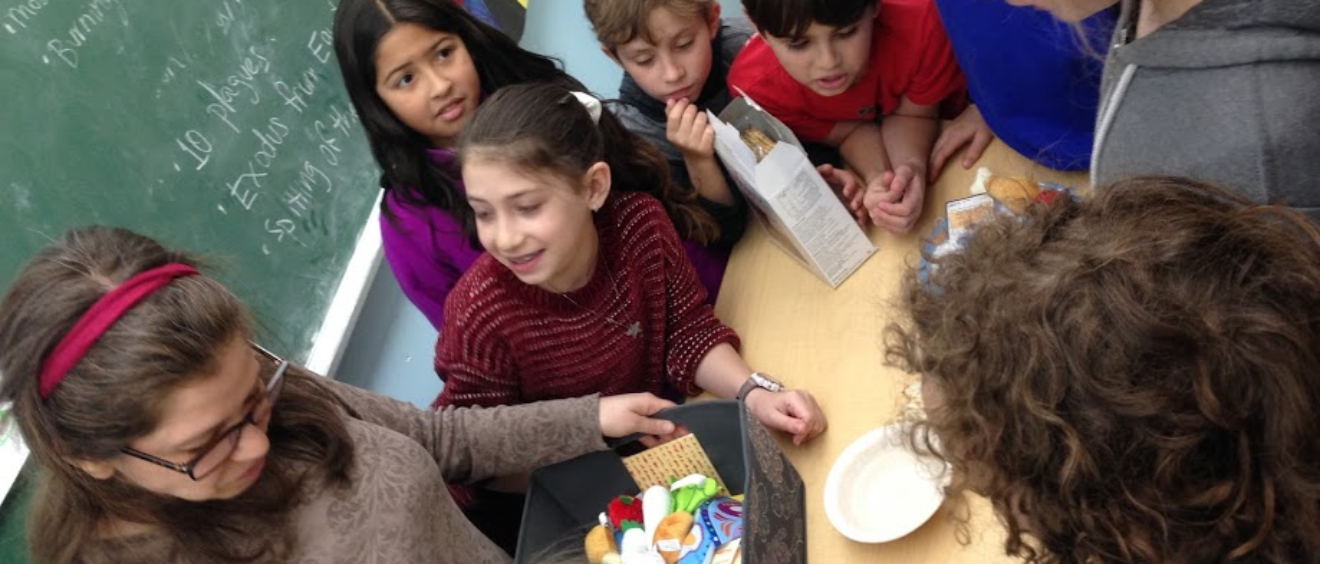
On Shabbat we looked at pictures and props of the ritual foods that go on a seder plate (ke’a’rah shel pesach) and followed various commands in Hebrew while engaging with the following parts: beitzah/egg, karpas/green vegetable and matzah/matzot. We then focused on the 3rd question of the Ma Nishtana song by following the command “litbol karpas pa’am echat, litbol karpas pa’amaim (dip the parsley once, dip the parsley twice) and practiced singing the 3rd question. On Tuesday, we reviewed body parts in Hebrew by playing a few rounds of “Shimon Omer/Shimon Says.” We then practiced saying the blessing before eating the matzah, and eating a small piece. We also practiced dipping karpas into salt water (litbol/to dip) and saying the blessing “borei pri ha’adamah” before tasting some. This coming Shabbat, we will follow commands that engage us with Charoset and maror (bitter herb) and practice the 4th question of Ma Nishtana.
Announcements
1. Save the Date: Passover Family Workshops & Concert!
Saturday April 13: Shabbat services begin at 9:30, followed by Passover Family Workshops at 10:30
Passover Around the World Workshops
Kindergarten through 4th grade families will travel the world learning about different Passover traditions through crafts, recipes, songs and more!
5th and 6th grade families will participate in a Seder Around the World!
All Yachad families are invited to join us! K-4th grade students must be accompanied by a parent or responsible adult.
2. Noah Aronson Concert
Following our Passover Workshops, join artist in residence, Noah Aronson, for a special family-friendly performance at 11:45. Free and open to all!
3. Havdalah Hootenanny Celebrating Sarah Grabiner
Saturday April 13, 5:30-7:30
Sing, learn, and say thanks to Sarah Grabiner for her 2 years of dedicated service as CBE’s cantorial intern! A brilliant, multi-talented teacher and prayer leader, Sarah has endeared herself to the Brooklyn Jews community; to Gan Shabbat families; to teen Torah chanters; and especially to our 2018 b’nei mitzvah, whose preparation she oversaw during Cantor Josh Breitzer’s sabbatical. Sarah recently accompanied many of those former b’nei mitzvah students to Israel as part of CBE’s largest-ever annual 8th grade trip. Following her ordination from Hebrew Union College-Jewish Institute of Religion in May, Sarah will relocate back to her native United Kingdom to serve Radlett Reform Synagogue. Join the clergy team, together with artist-in-residence Noah Aronson and musical members of all ages, as we send Sarah off with singing, stories and profound gratitude!